One of the things I enjoy about browsing thrift stores is that you never quite know what you’re going to find. Most trips don’t produce anything particularly remarkable. Every once in a while, though, you get lucky.
This time it was a CD.
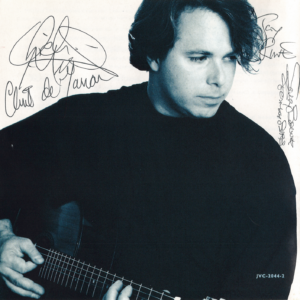
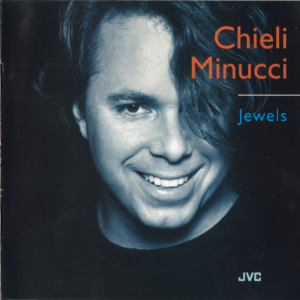
I came across a copy of Chieli Minucci’s Jewels, released by JVC Records in 1995 as JVC-2044-2. Being a fan of smooth and contemporary jazz, it was an easy addition to the collection. I noticed writing on the back of the CD insert, but at first I didn’t give it much thought. With used CDs, handwritten names, notes and other markings aren’t exactly unusual.
Then I looked more closely.
Wait…those aren’t printed
In the upper-left corner was a signature that looked like Chieli Minucci. What made that one particularly easy to identify was that elsewhere in the artwork was a printed example of Minucci’s signature. The handwriting on the back looked remarkably similar.
That made the other writing considerably more interesting.
Looking at the actual insert rather than a scan — where the differences between the ink and printed artwork are much easier to see — I could begin making out several more names.
Below Minucci appeared to be Clint deGanon. To the right of Minucci’s photograph was what looked like Jay Rowe. Running along the side was Jerry Brooks, accompanied by wording that included “BASS.”
Those aren’t random names associated with contemporary jazz. Rowe is a keyboardist with a long association with Minucci and Special EFX, Brooks is Minucci’s longtime bassist, and deGanon is a drummer who has performed with Minucci.
So now I had a 1995 Chieli Minucci CD apparently signed by:
Chieli Minucci — guitar
Jay Rowe — keyboards
Jerry Brooks — bass
Clint deGanon — drums
That raised the obvious question: Why would those particular four people have signed this particular CD?
The answer turned out to be surprisingly close to home.
Raleigh-Durham, October 1995
Chieli Minucci maintains an extensive history of his concert appearances. Buried in the listings for 1995 is this:
October 13–14 — Seldom Blues — Raleigh Durham, NC
with Jay Rowe, Jerry Brooks, Clint deGanon
There they were.
Not three of the names. Not a lineup that was close.
The exact four musicians whose signatures appear on my copy of Jewels.
That changes this from an interesting autographed CD into something with a plausible local history.
I bought the CD secondhand in the Raleigh area. Jewels was Minucci’s current solo album in 1995. And on October 13 and 14 of that year, Minucci performed in Raleigh-Durham with Rowe, Brooks and deGanon — precisely the four people who appear to have signed this copy. Minucci’s concert archive documents that lineup directly.
There is no dated inscription, receipt or original owner’s story accompanying the CD, so I can’t prove that the signatures were put there during those October performances. But the circumstantial evidence is unusually good.
A current 1995 album. Four signatures. The exact same four musicians appearing together locally that year. And, three decades later, the CD is still circulating in the Raleigh area.
I’d say October 13 or 14, 1995 at Seldom Blues is a very reasonable working theory for where this CD acquired its signatures.
And Jewels was doing pretty well
Researching the autographs led me down another rabbit hole: how was Jewels actually received when it was new?
Quite well, as it turns out.
Minucci was already well known as a founding member of Special EFX, but Jewels gave him considerable room to stretch out on his own. The album wasn’t simply an hour of interchangeable mid-’90s smooth jazz. Its ten compositions — with the title piece divided into four parts on some releases — wander through fusion, funk, rock, reggae, ambient textures and contemporary jazz. Minucci’s own discography confirms the impressive roster of musicians involved, including Jerry Brooks, Gerald Veasley, Lionel Cordew, George Jinda, Philip Hamilton, Mino Cinelu and others.
Contemporary reviewers noticed the variety. JazzTimes described Minucci as offering a “highly polished sound” while covering styles ranging from reggae to ambient music. Reviewer Jonathan Widran was even more enthusiastic about Minucci’s willingness to move among rock, blues, funk and acid jazz rather than settle into one safe contemporary-instrumental formula.
And listeners were actually hearing it on the radio.
On the July 21, 1995 Radio & Records NAC — New Adult Contemporary — chart, Jewels was the #7 album in the country, logging 418 reported plays. “Phat City” was overwhelmingly the most-played track, accounting for 342 of them. Minucci was sharing that chart with artists including Brian Culbertson, Rick Braun, Nelson Rangell, Urban Knights, David Sanborn, and Lee Ritenour & Larry Carlton.
That’s useful perspective today. Jewels wasn’t some obscure CD that disappeared unnoticed in 1995. Within the contemporary-jazz world, it was receiving significant radio exposure.
Looking back on the album, AllMusic described Jewels as the recording on which Minucci established his identity as a solo artist, balancing fusion, funk and acid jazz with the fiery guitar playing associated with his live performances.
Thirty-one years later
And that’s the part of collecting physical music that streaming can never quite duplicate.
I could pull up Jewels online and hear exactly the same music. In fact, the album remains available digitally today. But a streamed album can’t tell you where it has been.
This particular piece of plastic and paper apparently can.
Someone may have gone to Seldom Blues in Raleigh-Durham on October 13 or 14, 1995, carrying Minucci’s relatively new Jewels CD — or perhaps buying it in connection with the show. That person apparently met the musicians and had Chieli Minucci, Jay Rowe, Jerry Brooks and Clint deGanon sign the insert.
They kept it.
At some point over the next three decades, it left their collection. Eventually it wound up in a Raleigh-area thrift store, mixed in among countless ordinary used CDs.
Then I happened to pick it up.
And initially I didn’t even realize what I had found.
There is probably no great financial windfall hiding inside that jewel case. That’s really beside the point. What makes the CD special to me now is the little trail connecting an album released in 1995, four musicians, a pair of Raleigh-Durham performances, an unknown previous owner, a thrift-store shelf and me.
Sometimes the fun of collecting isn’t finding something valuable.
Sometimes you just get lucky.