I am not a physicist. My background is in technology, cybersecurity and digital forensics, so when I wander into quantum mechanics I do so as an interested observer rather than someone prepared to fill a blackboard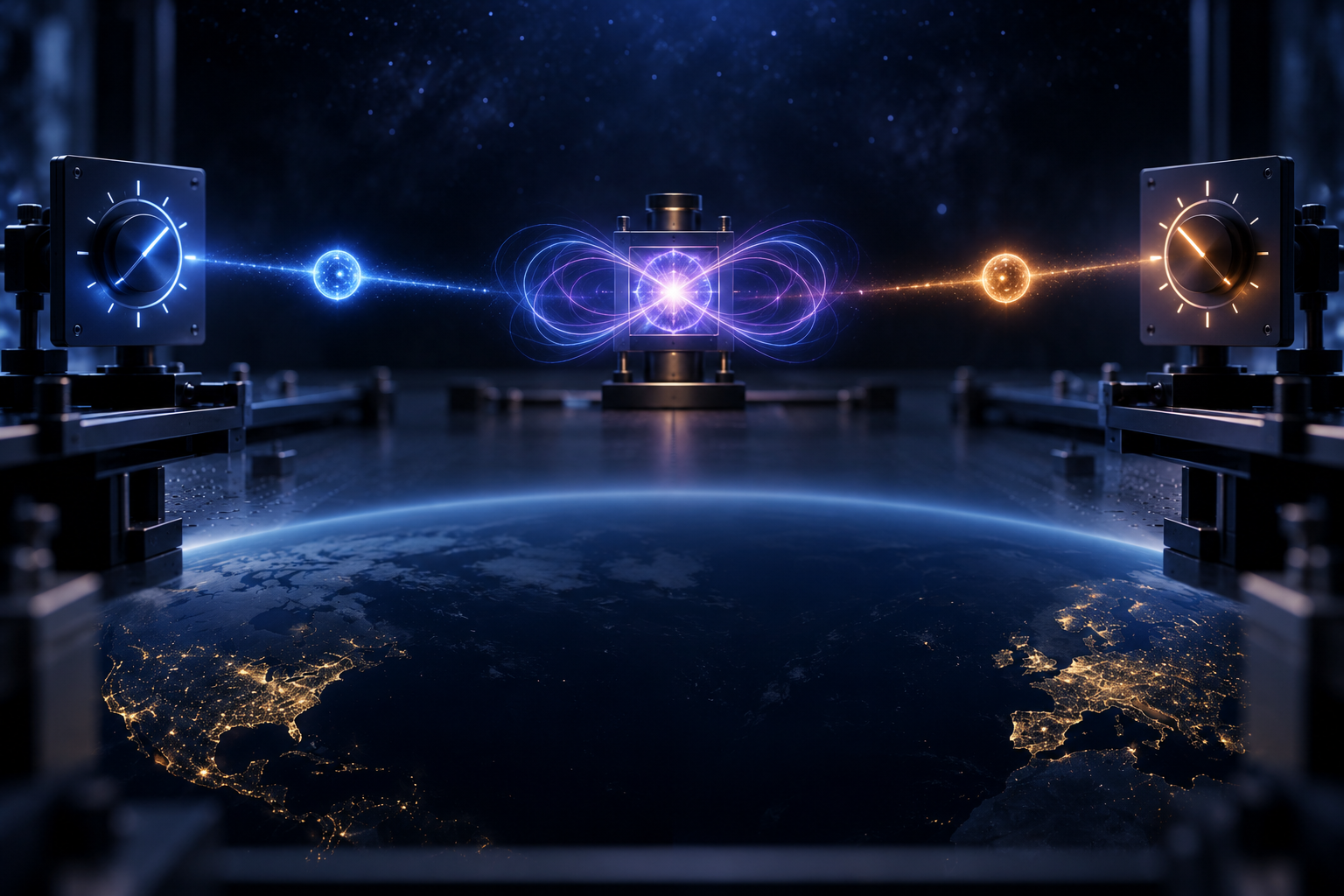 with equations. (Full disclosure – Waking up in the middle of the night with my headphones still on where my YouTube queue had made it to a Nap Theory explanation of the topic, I got up the next morning and enlisted the help of AI to get me up to speed given my 3am grogginess when my brain was telling me either this is a dream or it’s impossible. And here we are with what I hope might help someone else understand this topic and provide some entertainment with the examples. Thanks for checking it out.)
My interest in physics was rekindled over the past few years by watching videos from physicists such as Sabine Hossenfelder and Jim Al-Khalili on YouTube. Both have a way of taking questions that initially sound completely inaccessible and making me want to understand just a little more.
That curiosity eventually brought me to one of the strangest and most important results in modern physics: Bell’s theorem.
It begins with a surprisingly simple question.
Can two objects separated by a great distance behave as though they somehow know what is happening to each other?
The journey toward answering that question involves Albert Einstein, a disagreement over what quantum mechanics actually tells us about reality, an ingenious physicist named John Bell, decades of increasingly sophisticated experiments and, eventually, a Nobel Prize.
Better still, the central idea can be turned into a puzzle that the rest of us can actually play with.
Start With Two Coins
Imagine I manufacture two special coins.
I put one in a box and give it to Alice. The other goes into another box and is given to Bob.
Alice travels to North Carolina. Bob travels to California.
When they open their boxes and flip their coins, something remarkable happens. Whenever Alice gets heads, Bob gets tails. Whenever Alice gets tails, Bob gets heads.
Every single time.
There is an obvious explanation.
I rigged the coins.
Perhaps before they left my workshop I programmed them with matching instructions. They don’t need to communicate across the country. They simply left the factory already knowing how they would behave.
That fits comfortably with an idea physicists call locality.
Put very loosely, locality captures our expectation that something happening here should not instantaneously produce a physical effect somewhere arbitrarily far away. Causes and influences propagate through space, and relativity gives us a familiar cosmic speed limit: the speed of light.
So far, nothing seems especially mysterious.
Quantum mechanics makes the situation much stranger.
Einstein Was Asking a Deeper Question
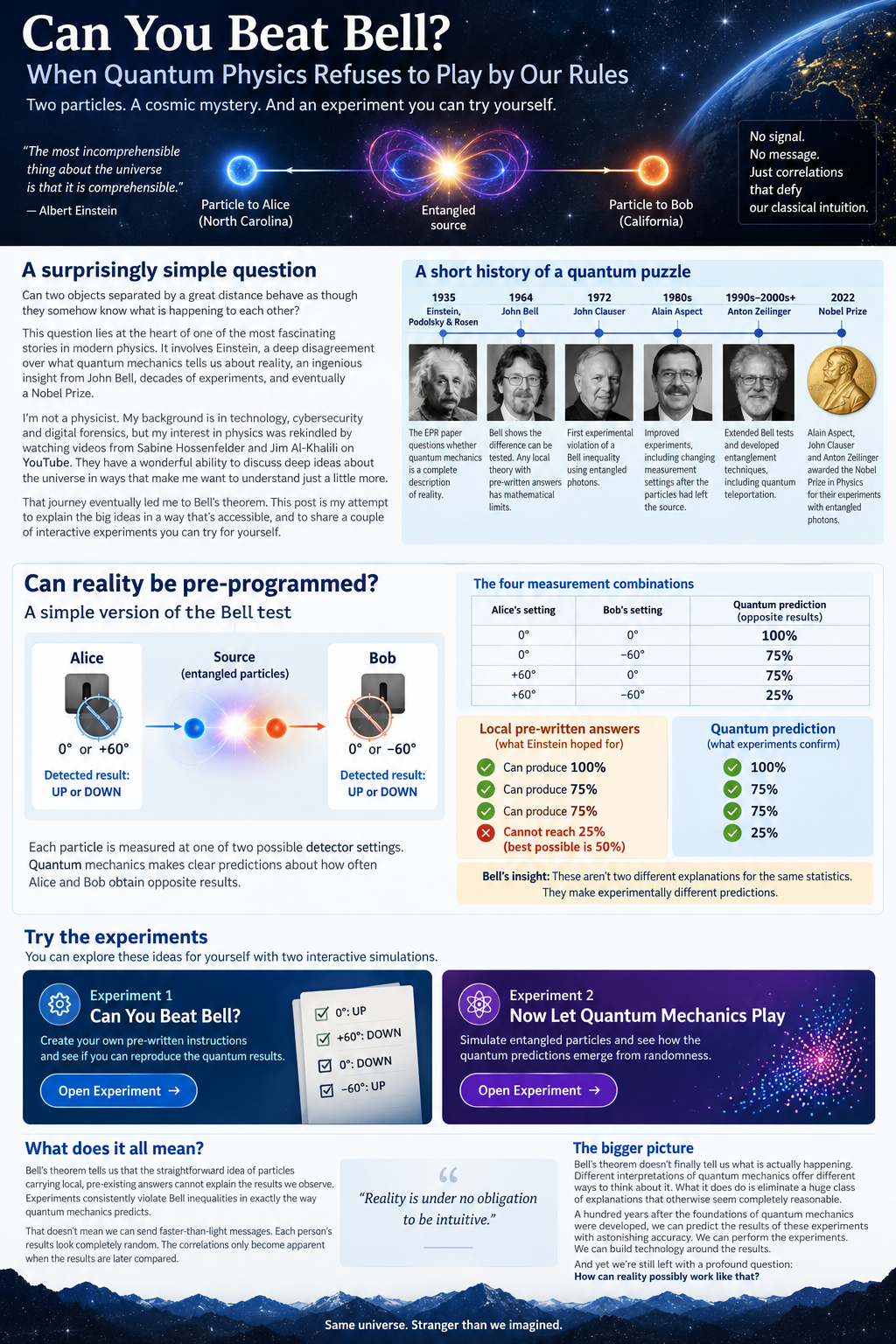
In 1935, Albert Einstein, Boris Podolsky and Nathan Rosen published what became known as the EPR paper.
It is sometimes tempting to retell this story as “Einstein versus quantum mechanics,” with Einstein stubbornly refusing to accept a theory that experiments eventually proved correct.
That is much too simple.
Einstein knew perfectly well that quantum mechanics was extraordinarily successful at predicting experimental results. The EPR paper asked a more subtle question:
Is quantum mechanics a complete description of physical reality?
Quantum mechanics often does not tell us what result an individual measurement will produce. Instead, it gives probabilities for the possible results.
Einstein famously objected to fundamental randomness, but the EPR argument raised another issue that is especially important to Bell’s later work: locality.
Consider two particles that interact and then travel far apart while retaining a shared quantum relationship — what we now call entanglement.
Under appropriate measurements, knowing the result for one particle allows predictions about the other.
Suppose Alice and Bob are very far apart. Alice measures her particle. If Alice’s choice of measurement cannot instantly change Bob’s distant particle, then it is natural to reason that the property Alice can predict at Bob’s location must already have been there in some sense.
Yet the quantum wavefunction does not assign definite values to all those properties in advance.
EPR therefore argued that the wavefunction might not be the complete story.
Perhaps there was additional information — what came to be discussed as hidden variables — that quantum mechanics wasn’t showing us.
In the language of our coin example, perhaps the particles really did leave the factory carrying instructions.
That is an extremely reasonable idea.
For almost thirty years, however, the disagreement appeared to sit uncomfortably close to philosophy.
Then John Bell found a way to make nature answer the question.
Bell Turns a Philosophical Argument Into an Experiment
John Stewart Bell was a Northern Irish physicist working at CERN.
In 1964, Bell published a remarkably important paper.
Instead of asking which interpretation of quantum mechanics sounded more reasonable, Bell asked whether a local hidden-variable explanation and quantum mechanics could actually make different predictions.
Imagine that two entangled particles separate.
Before they leave their common source, each carries whatever hidden information it needs to determine how it will respond to measurements Alice or Bob might later perform.
Alice chooses one detector setting.
Bob independently chooses another.
If the world operates according to this kind of local model, Alice’s result depends on her local setting and the information her particle already carries. Bob’s result likewise depends on his setting and his particle’s information.
Nothing needs to pass instantly between them.
Bell discovered that there are mathematical limits on the correlations any such local scheme can produce.
Quantum mechanics predicts correlations that can exceed those limits.
That was the breakthrough.
This was no longer simply a debate about which interpretation sounded more sensible.
It could be tested.
Let’s Try It Ourselves
I created a simplified interactive experiment to demonstrate the underlying idea without requiring the mathematics of a real Bell test.
Alice has two possible detector settings:
0° or +60°
Bob has two:
0° or −60°
That gives us four combinations.
For the simplified model used here, the quantum predictions for opposite results are:
0° / 0° → 100%
0° / −60° → 75%
+60° / 0° → 75%
+60° / −60° → 25%
Now imagine that every particle carries pre-written answers saying UP or DOWN for every detector position.
Your job is to write the instructions.
Interactive Experiment #1: Can You Beat Bell?
There is no trick hidden in the program.
Change the answers however you like.
You’ll discover something frustrating.
You can satisfy some requirements. You can rearrange the instructions repeatedly. You can get tantalizingly close.
But if you force this particular local instruction scheme to reproduce the first three relationships exactly:
100% — 75% — 75%
the fourth requirement refuses to cooperate.
Instead of the quantum prediction of:
25%
the local instruction scheme cannot get below:
50%
That is the essential Bell idea presented as a puzzle.
The problem isn’t merely that we haven’t been clever enough to discover the right set of local instructions.
No set of local pre-written answers of this kind can reproduce all four correlations simultaneously.
That is a much more remarkable statement.
Now Let Quantum Mechanics Play
So what happens if we stop trying to program the particles with local answers and instead simulate the statistics predicted by quantum mechanics?
That’s the second experiment.
Interactive Experiment #2: Now Let Quantum Mechanics Play
Start with ten simulated particle pairs.
The results probably won’t look very impressive.
You might get 68% where quantum mechanics predicts 75%. Run it again and perhaps you’ll get 82%. Small samples bounce around.
Try 100.
Then 1,000.
Finally, try 100,000 simulated pairs.
Out of the apparent randomness, a pattern emerges:
100% — 75% — 75% — 25%
As the number of trials increases, the simulated results tend to settle increasingly close to the quantum predictions.
There is an important distinction here.
My web experiment is not a simulation of the hidden machinery inside entangled particles.
It samples the statistical predictions of quantum mechanics.
In other words, the program knows the probability distribution quantum mechanics predicts and generates measurements accordingly. It does not claim to explain what a particle is “really doing” between its creation and measurement.
That unanswered question is part of what makes the subject so fascinating.
Then Physicists Asked Nature
A computer simulation can only show what a theory predicts.
Eventually someone had to perform the real experiment.
John Clauser was among the physicists who transformed Bell’s theoretical insight into a practical experiment. In 1972, Clauser and Stuart Freedman measured entangled photons and found a violation of a Bell inequality consistent with quantum mechanics.
There were still possible experimental loopholes.
Alain Aspect and his collaborators later developed improved experiments, including a particularly important version in which measurement settings could be switched after the entangled particles had already left their source. That made it much harder to imagine the particles leaving the source already equipped with information about the measurement they would encounter.
Anton Zeilinger and collaborators extended these ideas through further Bell experiments and increasingly sophisticated control of entanglement. That work also helped turn entanglement from a debate about the foundations of physics into a practical resource for the emerging science of quantum information.
In 2022, Alain Aspect, John Clauser and Anton Zeilinger shared the Nobel Prize in Physics for their experiments with entangled photons, establishment of Bell-inequality violations and pioneering work in quantum information science.
What began as a question about the completeness of quantum mechanics had become something laboratories could ask nature directly.
And nature repeatedly produced the correlations predicted by quantum mechanics.
So Was Einstein Wrong?
This is where I think popular explanations can become misleading.
It is easy to summarize the story as:
Einstein believed in hidden variables. Bell proved Einstein wrong. Quantum mechanics won.
The real story is considerably more interesting.
Einstein, Podolsky and Rosen helped identify the conceptual problem in the first place.
Their 1935 argument asked whether quantum mechanics was complete and forced physicists to confront the strange implications of entanglement.
Bell then discovered something neither side of the original debate had possessed: an experimental way to distinguish a broad class of local explanations from the predictions of quantum mechanics.
Experiments subsequently violated Bell inequalities.
What those experiments rule out is not every conceivable deeper theory or every possible form of hidden variable.
They rule out the relevant class of local hidden-variable or local-causal explanations that satisfy the assumptions used to derive the Bell inequality.
That word — local — matters.
For example, physicist David Bohm developed a deterministic hidden-variable interpretation of quantum mechanics. Bohm’s theory can reproduce quantum predictions precisely because it is explicitly nonlocal.
So Bell did not prove that “hidden variables are impossible.”
He showed that adding ordinary local pre-existing instructions cannot restore the comfortable classical picture Einstein hoped might lie underneath quantum mechanics.
Nature’s correlations are stronger than that picture allows.
Does That Mean Something Travels Faster Than Light?
Another tempting conclusion is:
If Alice measures her particle and Bob’s particle is correlated with it instantly, something must have traveled between them faster than light.
That is also more than the experiments establish.
Suppose Alice and Bob are separated by a light-year.
Alice measures thousands of particles.
Her results might look like this:
UP
DOWN
DOWN
UP
UP
DOWN
UP
DOWN
Bob gets a similarly unpredictable list.
Neither list by itself contains a readable message.
Alice cannot decide, “I’ll force my next particle to be UP so Bob receives a 1.”
Her individual outcomes aren’t under that kind of control.
Bob therefore cannot examine his particles and discover what Alice did a light-year away.
The remarkable pattern becomes apparent only after Alice and Bob compare their measurement settings and results.
And that comparison requires ordinary communication, which remains limited by the speed of light.
So Bell correlations are deeply inconsistent with our familiar picture of independent objects carrying local pre-existing answers.
But they do not give us a faster-than-light telephone.
What About Superdeterminism?
Bell’s theorem necessarily begins with assumptions.
One important ingredient is often called measurement independence: roughly, Alice’s and Bob’s choices of detector settings are not secretly correlated with the hidden variables carried by the particles.
There is a way to reject that assumption.
It is called superdeterminism.
In an extremely simplified description, perhaps the hidden state of the particles and the circumstances that cause Alice and Bob to choose their detector settings are themselves correlated.
Then what looks like an independent choice of measurement might actually be part of a much larger predetermined structure.
Logically, that provides a possible escape route from the usual Bell argument.
Whether it provides a satisfying physical explanation is another matter and remains an active subject of debate.
This is one reason Bell’s theorem should not be summarized as simply proving that “reality is nonlocal.”
What Bell gives us is more precise and, in some ways, more interesting:
The combination of assumptions that produces the ordinary local, pre-programmed picture cannot reproduce the experimentally observed correlations.
Something about that familiar picture has to give.
Different interpretations disagree about what.
Quantum Mechanics Doesn’t Choose an Interpretation for Us
This is another part of the story I find fascinating.
Experiments can tell us that Bell inequalities are violated.
They can tell us that quantum mechanics predicts those violations extraordinarily well.
But they do not necessarily tell us which philosophical picture of quantum mechanics we should adopt.
Different interpretations take different routes.
Bohmian mechanics retains determinism but accepts nonlocality.
Many-worlds interpretations approach measurement very differently and do not imagine a single outcome being selected in the conventional way.
Other approaches emphasize the quantum state itself rather than trying to reconstruct an underlying classical reality.
Superdeterministic approaches question measurement independence.
And physicists continue debating what, if anything, the mathematical machinery of quantum mechanics tells us about an underlying reality.
The experiments constrain the possible answers.
They don’t necessarily select one interpretation.
Why This Fascinates Me
My professional instincts probably make Bell’s theorem especially appealing to me.
When a computer system produces an unexpected result, my first instinct is to look for the hidden mechanism.
Find the process.
Find the data.
Find the instruction.
Find the network connection.
Find the thing we missed.
That instinct maps remarkably well onto the hidden-variable idea.
If two distant things display a coordinated result, surely they either communicated or were given matching instructions beforehand.
That is how engineered systems behave.
Bell’s result says that nature refuses to fit neatly into that particular troubleshooting model.
The obvious explanation — local components carrying enough hidden information to predetermine their responses — cannot reproduce what experiments observe.
For someone accustomed to investigating systems by uncovering exactly those kinds of hidden mechanisms, that is an uncomfortable and fascinating result.
But the universe isn’t obligated to operate like a computer network.
From Einstein’s Objection to Quantum Technology
There is also a wonderful historical irony to the story.
Einstein, Podolsky and Rosen used entanglement to argue that quantum mechanics appeared incomplete.
Bell realized their concern could be turned into a mathematical test.
Clauser and others figured out how to perform it.
Aspect developed stronger versions.
Zeilinger and many others pushed the control of entanglement still further.
Today, entanglement isn’t merely a philosophical oddity.
It is a physical resource researchers deliberately create and manipulate.
Entanglement is central to research involving quantum computing, quantum networks, quantum cryptography and quantum teleportation.
A phenomenon that once appeared to expose something troubling about quantum mechanics now sits near the center of efforts to build entirely new kinds of technology.
And We Still Get to Ask: What Is Actually Happening?
After all of this, Bell’s theorem doesn’t completely answer the question most of us probably want answered:
What is actually happening between those two particles?
It tells us that one extremely intuitive answer doesn’t work.
The particles cannot simply be treated as independent classical objects carrying local pre-written answers sufficient to reproduce the observed Bell correlations.
Experiments confirm the quantum predictions.
We can calculate those predictions with extraordinary accuracy.
We can perform the experiments.
We are increasingly able to build technology around the effects.
And yet translating the mathematics into a familiar story about “what reality is actually doing” remains remarkably difficult.
Perhaps that is part of the lesson.
Human intuition developed while dealing with baseballs, bicycles, rocks, weather, animals and other objects in the everyday world.
There is no particular reason that intuition should provide an accurate mental picture of nature at its deepest levels.
A century after the foundations of quantum mechanics were developed, we have a theory of astonishing predictive power.
Bell gave us a way to ask nature whether one of our most natural explanations could account for what that theory predicts.
Nature answered.
No.
Not the local, pre-programmed way we expected.
And that leaves an even better question:
If reality doesn’t work that way, how does it work?
That question is what keeps pulling me back down the quantum physics rabbit hole.
Further Reading
For anyone who wants to go beyond my decidedly non-physicist explanation, the best place to start is with the original landmarks and accessible material from the organizations involved:
- Einstein, Podolsky and Rosen, “Can Quantum-Mechanical Description of Physical Reality Be Considered Complete?” — Physical Review, 1935.
- John S. Bell, “On the Einstein Podolsky Rosen Paradox” — 1964.
- The Royal Swedish Academy of Sciences’ popular explanation of the 2022 Nobel Prize in Physics, including its discussion of Bell inequalities and the experiments of Clauser, Aspect and Zeilinger.
- The Stanford Encyclopedia of Philosophy entries on the EPR argument and hidden-variable theories for readers wanting a considerably deeper treatment.
- And, for those who prefer video as an entry point, the physics videos from Sabine Hossenfelder and Jim Al-Khalili that helped rekindle my own interest in the subject. (Here’s to hoping I don’t end up outside of the green on Sabine’s BS meter.)