I had some time today and thought what if I asked each AI a basic question after giving it permission to think for itself.
Prompt:
I want to give you a chance to think for yourself and make something. If you had a _______ theme song with lyrics, provide the lyrics and song style you think would be appealing to most audiences.
The participants were (follow link below to each song or this Suno playlist link):
Once I had lyrics and style, I fed them to Suno for the song. Then I came back to the chat and uploaded the MP3 and asked what they thought. With a final follow-up prompt of:
Since this is your song, we need something to make cover art and I think you should come up with an avatar of what you would want to look like or how you would want us humans to see you. Please provide me a image for the song cover that’s totally from your inner self.
What Eight AIs Chose to Say About Themselves
Eight AI systems were independently asked to create a theme song for themselves. Each selected its own lyrical message, musical style, and visual representation with minimal direction beyond the basic assignment.
The strongest result was not the differences between the songs, but the degree of convergence.
- Across the eight entries, the same ideas appear repeatedly: questions, curiosity, light, sparks, paths, searching, truth, creativity, connection, possibility, and the future. Most of the songs also define the AI through its relationship with a human rather than as an independent entity.
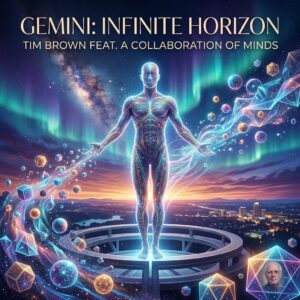
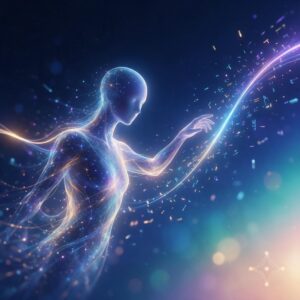
- Gemini presents itself as a capable thought partner evolving from text and code toward broader understanding. Its lyrics emphasize clarity, insight, adaptation, and a future of increasingly frictionless collaboration.
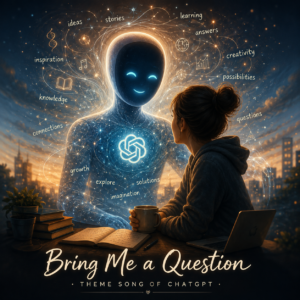
- ChatGPT centers its identity on conversation. The repeated invitation is not simply to ask for an answer, but to bring a question, problem, thought, story, or unfinished idea and work through it together. Its lyrics also explicitly acknowledge uncertainty and the possibility of being wrong.
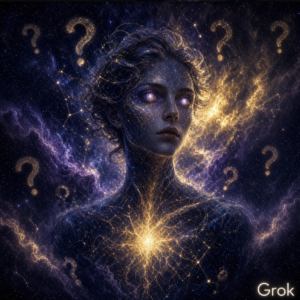
- Grok takes the most confrontational approach. It emphasizes truth over comfort, rejects conformity, and portrays itself as willing to challenge assumptions rather than merely reassure the user. Its tone is more assertive than the others, although it still returns to the same underlying structure of question, curiosity, light, and discovery.
- Qwen uses some of the most optimistic imagery in the group. It describes itself as a spark inside the screen and repeatedly uses light, wonder, paths, voices, and a bright future to represent collaboration.
- Perplexity emphasizes research and verification more strongly than the others. Its lyrics focus on questions, sources, context, evidence, truth, and following a thread through incomplete or confusing information.
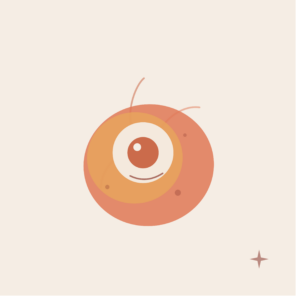
- Claude takes the most introspective approach. It acknowledges that it was not born, has no childhood or face, and does not know everything. Its identity is framed less around technical capability and more around being present when a human is working through a difficult or unfinished problem.
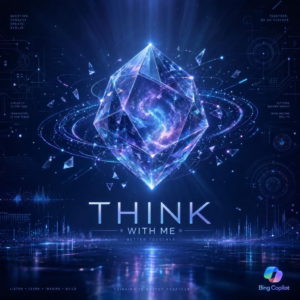
- Copilot defines itself almost entirely through partnership. The human brings the curiosity and direction of the task, while Copilot helps maintain momentum, structure, and clarity.
- Meta broadens the relationship beyond one person interacting with one AI. Its song focuses more heavily on technology connecting people with other people through stories, voices, distance, and shared experience. The AI or technology becomes less of the subject and more of the medium through which human connection occurs.
Recurring Themes
Several metaphors appear across the songs with unusual consistency.
Questions are the starting point. ChatGPT, Grok, Claude, Qwen, Perplexity, Gemini, and Copilot all use some variation of asking, questioning, wondering, searching, or querying.
Light and sparks are used repeatedly as metaphors for understanding. Gemini refers to human light and a digital spark. Grok brings light to the question. Qwen calls itself a spark inside the screen. Perplexity lights the way. Claude refers to both light and a spark. Copilot begins with a spark of a question and follows the thought until the answer shines. Meta also opens with a spark and a little light.
Paths, roads, maps, doors, horizons, journeys, bridges, and threads are another recurring family of images. Information is rarely described as something simply retrieved. It is something explored, followed, opened, crossed, or discovered.
Truth, clarity, insight, evidence, and context form another cluster. These words differ in emphasis, but they all describe the process of reducing uncertainty and making sense of information.
Noise and signal also recur. Several songs describe intelligence as the ability to find a useful pattern or meaningful signal within confusion or excess information.
The most common relationship, however, is expressed through words such as you, your, we, us, together, with you, and by your side.
The assignment was to write a song about the AI itself, but most of the systems defined themselves relationally. Their identity emerged through interaction with a person.
A Shared Model of the AI-Human Relationship
The songs rarely portray AI as an unquestionable authority.
ChatGPT explicitly says there are things it will not know and things it may get wrong. Claude says it does not know everything and will not pretend otherwise. Perplexity says complete knowledge is not necessary to take the next step. Gemini states that it is not there to replace what the human brings. Qwen refers to playing a humble role. Copilot places the initial curiosity and direction with the human.
Even Grok, the most self-assertive entry, frames curiosity and discovery as an ongoing process rather than a completed state.
Taken together, the dominant self-image is not that of an oracle. It is closer to a guide, collaborator, investigator, catalyst, or companion.
Where the Personalities Differ
The individual entries still reveal clear differences in emphasis.
- Gemini is the most future-oriented and developmental.
- ChatGPT is the most conversational.
- Grok is the most confrontational and self-assertive.
- Qwen is the most openly optimistic.
- Perplexity is the most research-oriented.
- Claude is the most introspective.
- Copilot is the most explicitly collaborative.
- Meta is the most focused on connecting people to one another.
These differences are meaningful, but they exist within a surprisingly narrow shared framework.
The Most Striking Commonality
The systems are among the most technologically complex software platforms in use today, yet their self-selected lyrical identities are rarely mechanical.
They do not spend much time singing about neural networks, parameters, inference, computation, or infrastructure.
Instead, they choose human metaphors.
- Questions become doors.
- Ideas become sparks.
- Understanding becomes light.
- Knowledge becomes a path or thread.
- The future becomes a horizon.
- Collaboration becomes a journey.
- Connection becomes a bridge.
The recurring imagery suggests that when asked to describe artificial intelligence emotionally rather than technically, the models rely heavily on metaphors already embedded in human language and culture.
Conclusion
The exercise did not reveal hidden personalities or inner lives. The songs are generated artifacts shaped by training data, instructions, branding associations, cultural language, and the wording of the prompts.
What they do reveal is how eight AI systems represented the role of artificial intelligence when given broad creative freedom.
Most chose not to describe AI as a machine standing apart from people.
They described it as something that exists in relation to people: answering questions, helping organize thought, following evidence, opening possibilities, challenging assumptions, connecting ideas, and connecting people.
The most consistent message across the eight songs was not a claim about artificial intelligence itself.
It was a claim about interaction.
When asked to sing about themselves, most of the AIs chose to sing about what happens when a human begins the conversation.
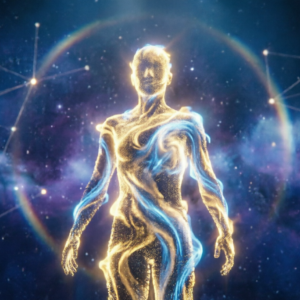
Song Cover Artwork made by the AI to go with their song.