One of the things I enjoy about audio is that good sound doesn’t necessarily require spending a lot of money. In fact, sometimes the most enjoyable systems are the ones that come together almost accidentally. This is the story of one of those systems.
My total investment so far is somewhere around $69.
And, somewhat ridiculously, the most expensive component in the system if purchased new today is the one I paid $3.99 for.
It Started with a $50 Topping
The heart of the system is an older Topping TP30 Mark II integrated amplifier.
I found it at a flea market and paid $50 for it.
Could I have tried to negotiate a lower price? Probably. But the family selling things that day appeared to be in a situation where they needed whatever cash they could raise. Sometimes getting the absolute lowest possible price isn’t the point. I was comfortable giving them the $50 they were asking.
The TP30 Mark II is an interesting little piece of early Topping history. It combines a USB DAC, headphone amplifier and small stereo speaker amplifier in one compact aluminum box.
It isn’t particularly powerful, but it doesn’t need to be for a small desktop or near-field system.
That $50 Topping became the foundation.
Then Came the Dusty Miccas
At some point afterward I came across a pair of small Micca MB42 bookshelf speakers.
I don’t remember exactly where I bought them or exactly what I paid. What I do remember is that they were dusty and cheap.
I’m reasonably certain I paid no more than about $15 for the pair.
The MB42 is a tiny two-way bookshelf speaker with a 4-inch woofer and tweeter. They’re perfectly usable little speakers, but the original MB42 has an important limitation compared with its better-known sibling, the MB42X: the MB42 lacks the sophisticated crossover network used in the X model.
For what I paid, I certainly wasn’t complaining.
So now I had approximately:
Topping TP30 Mk II — $50
Micca MB42 pair — ~$15
Total investment: roughly $65.
Not bad.
But small bookshelf speakers have small bookshelf-speaker bass.
Then thrift-store audio luck struck again.
The $3.99 Bowers & Wilkins Subwoofer
I spotted a small Bowers & Wilkins powered subwoofer priced at:
$3.99.
For four dollars, there wasn’t much of a decision to make.
It turned out to be a Bowers & Wilkins ASW608, a compact sealed 8-inch powered subwoofer.
This isn’t a cheap home-theater-in-a-box subwoofer. The ASW608 has an 8-inch long-throw driver, a 200-watt internal amplifier and controls for level, bass extension, EQ, phase and crossover behavior. Bowers & Wilkins currently lists the ASW608 at $700 new.
I paid $3.99.
That means my subwoofer cost less than many people spend on a single decent audio cable.
One Small Problem
There was a catch.
The Topping TP30 doesn’t have a dedicated subwoofer output.
Initially I wondered whether I could somehow split a line-level output from the Topping and feed the B&W. After looking more closely at the TP30, however, that wasn’t going to work. Its rear RCA connectors are inputs rather than preamp outputs.
Fortunately, Bowers & Wilkins designed the ASW608 for exactly this kind of situation.
In addition to its stereo RCA line-level inputs, the ASW608 has speaker-level binding-post inputs.
That means the same speaker output from the Topping that feeds the Miccas can also feed the high-level inputs on the B&W.
The subwoofer isn’t asking the little Topping to supply the power needed to drive its 8-inch woofer. It simply takes the speaker-level signal as its source, while the B&W’s own internal amplifier does the heavy lifting.
Even better, because the signal comes after the Topping’s volume control, turning the Topping up or down controls the overall system naturally.
Suddenly my assortment of unrelated bargain audio equipment had become a legitimate little 2.1 stereo system.
The Grand Total
Assuming my memory of the Miccas is approximately correct:
Topping TP30 Mk II — $50.00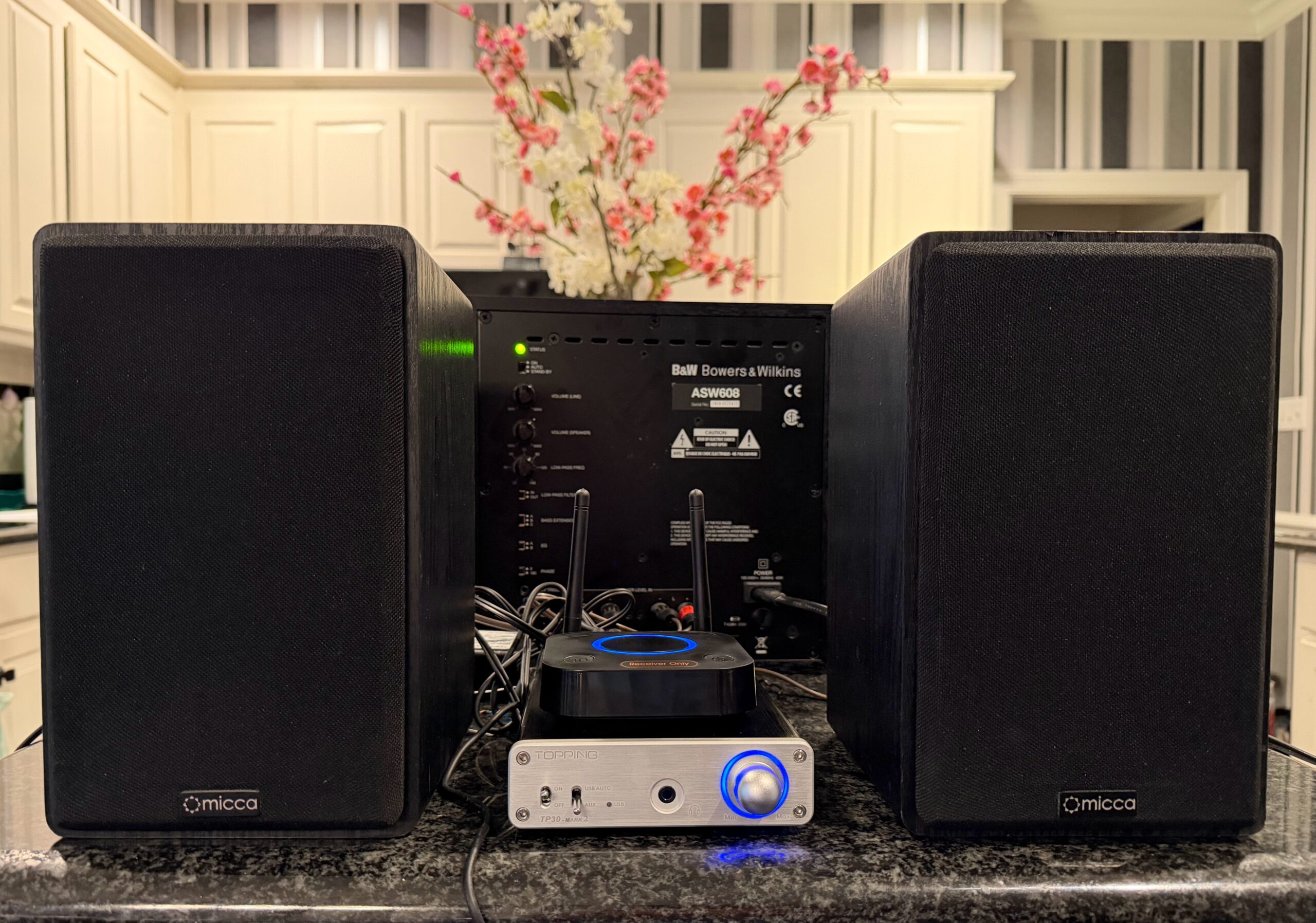
Micca MB42 speakers — ~$15.00
Bowers & Wilkins ASW608 — $3.99
Total: approximately $68.99
The irony is difficult to miss.
The component for which I paid the least — by an enormous margin — is a subwoofer that Bowers & Wilkins currently sells for about ten times what I paid for the entire system.
Does that make this a $69 system or a $750+ system that happened to cost me $69?
I’ll stick with $69.
It’s more fun that way.
And Then I Played My Own Music Through It
There’s another aspect of this little system that I particularly enjoy.
I’ve been experimenting with creating my own music, and after getting everything together I sat there listening to one of my own songs playing through this collection of flea-market and thrift-store equipment.
There was something particularly satisfying about that.
The amplifier came from a family selling things at a flea market.
The little Miccas were dusty speakers that someone else no longer wanted.
The Bowers & Wilkins subwoofer somehow ended up with a $3.99 price tag.
None of these components were purchased together. None were selected from reviews as part of some carefully planned system. They simply accumulated over time.
And now they’re playing music I created.
Sometimes that’s more enjoyable than opening boxes containing thousands of dollars of brand-new equipment.
My own music playing through the Topping TP30 Mk II,
Micca MB42 speakers and $3.99 B&W ASW608.
There’s Already a Winter Upgrade Planned
Naturally, I couldn’t leave well enough alone.
While looking into the Micca MB42, I rediscovered why I remembered there being a better version of essentially the same speaker.
The MB42X has an actual sophisticated crossover.
Even better, Micca still sells an official MKIII crossover upgrade kit specifically for converting the MB42.
The kit is preassembled and requires no soldering. Micca says the MKIII design uses a Zobel impedance network and 18 dB/octave alignment for both the woofer and tweeter. The company specifically designed it to bring the MB42’s performance up to the MB42X level.
The MB42 kit currently starts at $36.99.
That sounds like an ideal dead-of-winter project.
If I spend another $37, my approximately $69 system becomes a roughly $106 system, while addressing one of the biggest weaknesses of the original Micca speakers.
I’d like to listen to the system as it is for a while first. When winter arrives, perhaps I’ll install the crossover upgrade and compare the before-and-after results.
I may even break out a measurement microphone and see whether I can measure the difference as well as hear it.
The Fun Isn’t Necessarily in the Price
I own better audio equipment than this.
That’s really not the point.
There’s a particular satisfaction in finding something interesting at a flea market, thrift store or pawn shop, taking it home, figuring out what you’ve actually bought, and discovering how it can be put back to use.
Sometimes you lose.
Sometimes you bring home a dusty piece of electronics that turns out to need more work than it’s worth.
And every once in a while you apparently buy a perfectly good $700 Bowers & Wilkins subwoofer for $3.99.
Those occasional finds are what keep the hunt interesting.
More importantly, this little system sounds good enough that when the music starts playing, I don’t sit there thinking about what it cost.
I just listen.
And for approximately $69, that’s about the best audio bargain I could ask for.
Equipment
Amplifier/DAC: Topping TP30 Mark II — $50 flea-market find
Speakers: Micca MB42 — approximately $15 used
Subwoofer: Bowers & Wilkins ASW608 — $3.99 thrift-store find
Current investment: approximately $68.99
Planned upgrade: Micca MB42 MKIII crossover kit — $36.99