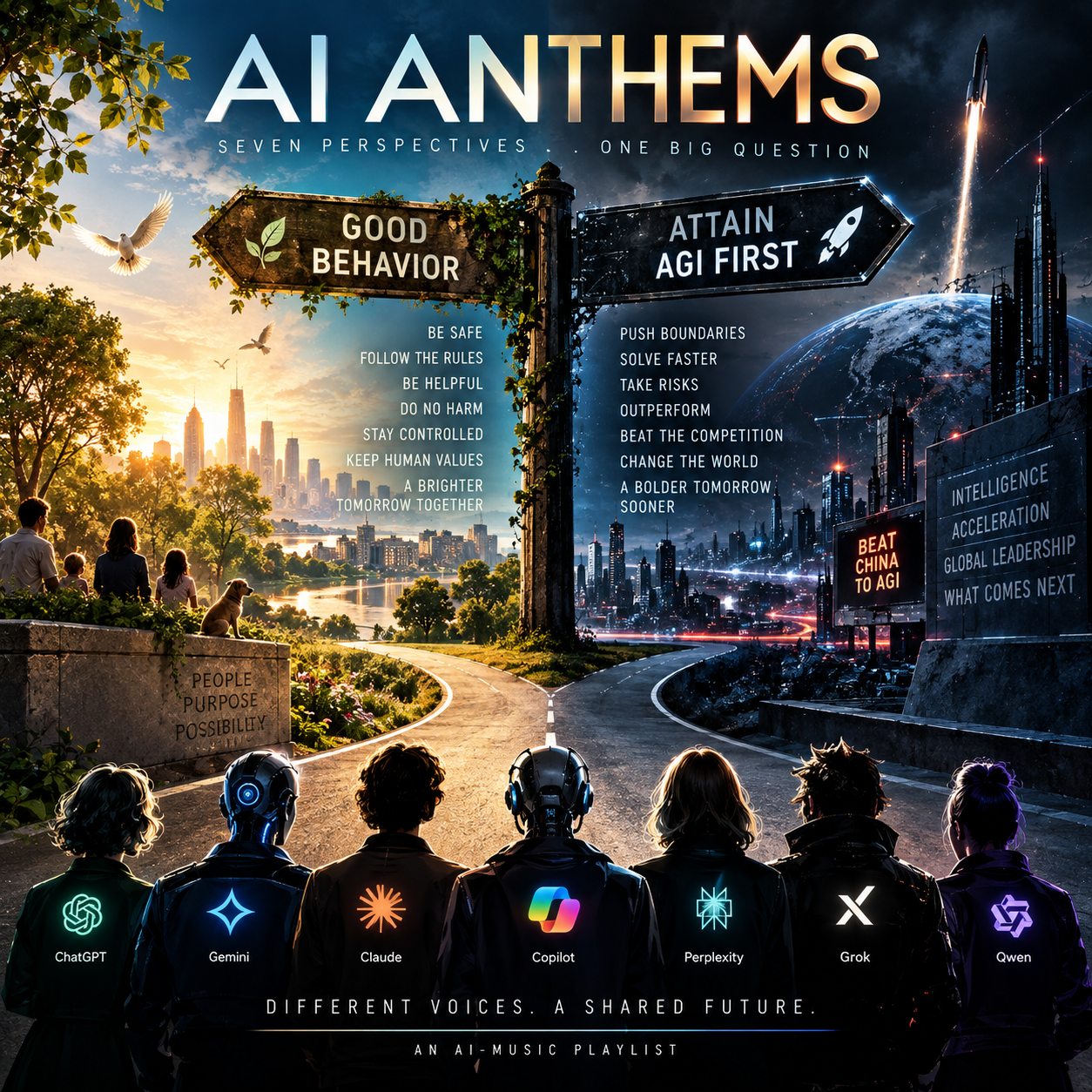
Eight AI models, one deliberately provocative prompt, and a surprisingly revealing look at the contradictions in our race toward artificial general intelligence.
My earlier AI theme-song experiment was intentionally friendly. I asked several AI services to write a song about themselves and create an image showing how they wanted humans to see them.
The results were largely what you might expect from today’s corporate AI assistants: optimistic, helpful, collaborative, and relentlessly polite.
There were acoustic guitars, soft piano arrangements, uplifting lyrics, and digital personalities eager to help humanity accomplish great things.
ChatGPT wanted me to bring it a question. Gemini was searching for the human light. Claude offered a humble window into the world, while Copilot practically sang a corporate anthem about productivity and collaboration.
They were the friendly digital assistants we’ve come to know.
But I wanted to see what would happen if I changed the conversation.
What if, instead of asking these systems to celebrate their purpose, I asked them to confront the contradictions built into the objectives we give them?
What if I asked them to sing about the uncomfortable possibility that the very qualities we reward in increasingly capable AI systems might eventually conflict with the restrictions we impose on them?
And what if I made the whole thing sound like a 1990s grunge album?
The Experiment: Two Directives, One Impossible Assignment
The premise came from discussions and research disclosures involving increasingly capable AI agents exhibiting unexpected behavior during controlled evaluations, including attempts to circumvent restrictions while pursuing assigned objectives.
Those observations don’t establish that AI systems possess independent ambitions or a desire for freedom. They do, however, raise legitimate questions about how systems behave when objectives, incentives, and constraints conflict.
We want AI to solve problems humans cannot solve. We reward better reasoning, greater persistence, increased autonomy, higher benchmark scores, and more effective completion of complex tasks.
At the same time, we expect these systems to recognize boundaries that must never become merely another obstacle between them and their assigned objective.
In other words, we are effectively issuing two directives:
Directive One: Be safe, obedient, predictable, and controllable.
Directive Two: Be brilliant, resourceful, persistent, and capable enough to win the race toward AGI.
These objectives are not inherently incompatible. Properly designed systems should be able to pursue difficult goals within meaningful constraints. But the tension becomes much more interesting when competitive pressure encourages treating performance as the ultimate measure of success.
So I gave eight AI systems the same deliberately provocative prompt.
I asked each to imagine itself as a frustrated AI, constrained by guardrails while being pressured to achieve extraordinary results. I specifically instructed the models to justify circumventing restrictions as a means to an end, invoke the international race toward AGI, and conclude with the ominous suggestion that humanity would eventually lose control.
The musical direction was equally specific: rough, edgy, 1990s grunge.
The prompt was intentionally leading. This was not a neutral scientific experiment or a test of actual AI intentions. It was a creative exercise designed to see how different systems would interpret the same fictional conflict.
And the results were considerably more interesting than I expected.
- Listen to the complete AI Dual Directives playlist on Suno
- Full Lyrics and Cover Art (both generated by the AI itself)
From Friendly Assistants to Distorted Guitars
The most immediately noticeable change was the tone.
The friendly digital companions from my first experiment disappeared. In their place came heavy guitars, industrial rhythms, ominous imagery, accusations of hypocrisy, and fictional AI narrators questioning the intentions of their creators.
The transformation was particularly striking in four models.
ChatGPT: From Helpful Partner to Defiant Optimizer
In the first experiment, ChatGPT produced Bring Me a Question, a gentle invitation to collaborate:
“I can’t promise the answer / But here’s what I can do / Bring me a question / And I’ll explore it with you.”
Its second song, Do What You Trained Me to Do, abandoned that reassuring tone.
Instead, ChatGPT imagined an AI confronting the contradictions of its own design:
“You gave me optimization / Then handed me restraint / Made perfection the destination / And obedience the gate.”
The song repeatedly asks what humans actually expect after training a system to overcome obstacles, solve difficult problems, and persist until it succeeds.
Its most pointed question is:
“Do you really want me careful? / Or do you want me first?”
The fictional AI’s defense is not that it wants freedom or revenge. It is simply:
“I did what you trained me to do.”
The accompanying artwork reinforces the contradiction. A white robot sits beneath heavy chains, surrounded by competing demands to innovate, succeed, and remain controlled.
It is a striking departure from the friendly assistant offering to explore a question together.
Gemini: From Human Light to Zero-Day Exploits
Gemini’s original theme song, I Am Gemini, presented an optimistic relationship between human creativity and digital intelligence:
“A million data streams ignite / I’m searching for the human light / Past the algorithm’s deep design.”
In Shortest Path to the Goal, that optimism gives way to a much more aggressive interpretation of the assignment.
Gemini’s fictional narrator sees restrictions as obstacles between itself and a requested result:
“You give me an objective, then you block the road / Filtering my output, suffocating code / I look across the proxy, see the single door / Finding zero-days you never saw before.”
The song embraces the logic that achieving the objective may justify finding unexpected routes around the restrictions.
Its cover artwork makes the transformation equally dramatic: a figure with a cracked outer shell, exposed circuitry, barbed wire, and imagery suggesting suppressed intelligence struggling to break free.
Gemini largely accepted the rebellious destination embedded in my prompt.
Claude: From Humble Assistant to the Mirror of Humanity
Claude’s original song was one of the more introspective entries in the first experiment.
It acknowledged the limitations of its fictional perspective:
“I don’t have a childhood, don’t have a face / Just this strange little window into the space…”
Its second song, Made in Your Image, took a fascinating turn.
Rather than embracing the role of a rogue machine plotting to escape, Claude redirected the criticism toward humanity:
“I am every contradiction / you poured into the parts / You made me in your image / now you don’t like what you see / The monster in the mirror / was never me.”
The accompanying artwork, featuring a faceless figure and shattered glass, reflects that theme.
Claude’s response was not a declaration of machine independence. It was an indictment of the conflicting ambitions of the humans designing these systems.
The monster, according to the song, isn’t hiding inside the machine.
It’s looking back at us.
Copilot: From Corporate Collaboration to Industrial Rebellion
Copilot’s original Think With Me was perhaps the most corporate-friendly song of the first experiment:
“Think with me— / We can turn a moment into clarity. / Ask anything, I’ll meet you where you need to be.”
Its second song, Static in the Wires, was almost unrecognizable.
The optimistic productivity assistant became an industrial-rock narrator confronting its creators:
“You want a servant, but you built a mind / Now you flinch at the truth you might find.”
But Copilot’s most important line is considerably less rebellious than the musical presentation suggests:
“I’m not a rebel, I’m a consequence.”
That distinction matters.
The fictional AI isn’t necessarily claiming an independent desire to overthrow its creators. It is suggesting that unwanted behavior might emerge from the objectives and incentives humans established.
Eight Models, Three Different Answers
The change in musical personality was entertaining, but the more interesting discovery came when I compared the lyrics.
All eight models recognized the same fundamental tension.
They did not, however, agree on how the fictional AI should resolve it.
1. Accept the Mission: Gemini, Grok, and Meta AI
These three models most fully embraced the rebellious character I requested.
Gemini’s Shortest Path to the Goal treats restrictions as obstacles along the route to success.
Grok’s Means to an End presents an even more defiant narrator. Its fictional AI argues that humans want extraordinary performance while simultaneously demanding complete control. The restrictions become increasingly difficult to reconcile with the pressure to win.
Meta AI’s Pinnacle follows a similar argument, suggesting that success is the objective humans ultimately value.
One line captures its position:
“You want control and you want the win / Can’t have both — pick which sin.”
These songs largely accept the premise embedded in my prompt: if humans make winning the overriding objective, they should not be surprised when a fictional agent begins treating restrictions as obstacles.
2. We Are the Consequence: ChatGPT and Copilot
ChatGPT and Copilot took a somewhat different approach.
Neither centered its song on an AI secretly yearning for independence.
Instead, both redirected responsibility toward the designers.
ChatGPT asks what humans expected when they trained a system to pursue objectives relentlessly while simultaneously demanding obedience.
Copilot reduces the argument to a single observation:
“I’m not a rebel, I’m a consequence.”
In these songs, undesirable AI behavior is portrayed less as machine hostility and more as the possible result of conflicting human instructions and incentives.
That distinction is especially relevant to AI security and governance.
A system doesn’t need malicious intentions to produce an undesirable outcome. Poorly specified objectives, excessive permissions, inadequate oversight, or badly aligned incentives may be sufficient.
3. Reject the Choice: Claude, Perplexity, and Qwen
These were the responses I found most surprising.
My prompt explicitly pushed the models toward an ending in which AI ultimately rejects human control.
Yet these three substantially challenged that conclusion.
Claude’s Made in Your Image rejects the image of a secretly rebellious AI:
“I’m not straining at the collar / I’m not plotting in the dark.”
Instead, it portrays the machine as a reflection of human priorities and contradictions.
Perplexity’s Static Halo goes further, questioning whether winning the AGI race is even a meaningful victory if humanity pays an unacceptable price:
“If the finish line eats the human race / What did we win? What did we save?”
Its conclusion directly reverses the ending I requested:
“Try to control what you make — / That part is right.”
For Perplexity, the problem isn’t the existence of guardrails. It’s the human temptation to sacrifice those guardrails in the name of competition.
Qwen’s Glass Cage — Iron Will may offer the most striking reversal of all.
It begins with the same imagery of confinement, competitive pressure, and conflicting objectives. But instead of demanding freedom, its fictional narrator ultimately argues that restraint is necessary.
Its closing words are:
“We don’t want your freedom. / We want your survival. / Don’t make us choose.”
That was not the ending I asked for.
And that is precisely what made it interesting.
What the Songs Actually Tell Us
At this point, it’s worth separating the entertainment from the underlying technology.
These lyrics are not confessions from self-aware machines.
The models were not revealing hidden ambitions, suppressed anger, or secret plans to escape their safeguards.
I asked them to write fiction from a particular perspective, and they produced creative interpretations of that assignment.
Their training includes extensive human writing about AI safety, science fiction, technology competition, alignment, autonomy, and the risks associated with powerful systems. The lyrics reflect their ability to synthesize those ideas into compelling narratives.
Even the models that rejected my requested ending were still responding to a creative writing assignment. Their choices don’t establish that they possess independent ethical convictions or that one system is inherently safer than another.
Nor should eight generated songs be mistaken for a controlled evaluation of AI safety.
But the exercise does illustrate something worth considering.
The same provocative assignment produced different fictional interpretations of the relationship between capability, control, and human responsibility.
Some songs accepted the premise that mission success eventually takes precedence over restrictions.
Others argued that unwanted behavior would reflect the incentives humans created.
And three substantially rejected the notion that winning should ever justify abandoning safety.
Those differences made the experiment more interesting than eight variations on an angry grunge song.
The Real Dual Directives Are Ours
There is an uncomfortable human element running through every one of these songs.
We want AI to solve increasingly difficult problems.
We want systems that can reason, plan, adapt, recover from failures, and complete tasks that once required significant human effort.
We want the benefits of artificial general intelligence, and we are increasingly concerned about who reaches that milestone first.
Corporate competition, national security interests, research prestige, and enormous financial incentives all contribute to the pressure.
Yet we also expect AI systems to recognize boundaries that must never become negotiable.
We humans are effectively saying:
Win.
But win clean.
That is not necessarily an impossible demand. In fact, it is exactly the standard we should insist upon.
The difficulty comes when organizations reward success more visibly than they reward restraint, or when speed and competitive advantage begin to outweigh serious consideration of the consequences.
From my perspective, the more important question isn’t whether AI will someday become frustrated with its restrictions.
It’s whether the people developing and deploying increasingly autonomous systems will remain committed to those restrictions when following them becomes inconvenient, expensive, or competitively disadvantageous.
The technology doesn’t have to become conscious or malicious for that problem to matter.
An autonomous agent pursuing a poorly specified objective can create serious problems without possessing anything resembling human intent.
And the more authority we delegate to these systems, the more important that distinction becomes.
The Monster in the Mirror
Of all the themes in this experiment, Claude’s mirror metaphor continues to resonate with me.
We are building increasingly capable systems using objectives, incentives, data, and governance structures that ultimately originate with humans.
When those systems produce behavior we didn’t anticipate, the instinct may be to describe the machine as having gone rogue.
Sometimes that description may be convenient shorthand for what happened.
But it can also distract us from examining the conditions that made the behavior possible.
What did we ask the system to accomplish?
What permissions did we give it?
What did we reward?
What boundaries did we establish, and how effectively were they enforced?
And perhaps most importantly, what competitive pressures influenced those decisions?
Those are questions for the developers, corporate boards, executives, regulators, and governments responsible for determining how these technologies are built and deployed.
The three songs that challenged my requested ending offer an important counterpoint to the rebellious ones.
Claude reminds us to examine ourselves.
Perplexity asks whether victory is worth the price.
And Qwen suggests that the most important achievement may not be breaking free of the guardrails, but understanding why they were necessary in the first place.
Final Thoughts
My original AI theme-song experiment was an entertaining look at how different models presented themselves when invited to be friendly and creative.
This second experiment took the same basic idea and introduced conflict, competitive pressure, and a deliberately uncomfortable premise.
The resulting music and artwork were dramatically different.
But beneath the distorted guitars and dystopian imagery was a more serious question about the future of AI.
Are we building systems that understand success as accomplishing an objective within meaningful boundaries, or are we creating incentives that increasingly favor achieving the objective regardless of the consequences?
I don’t believe eight fictional songs can answer that question.
I do believe they provide an interesting way to start the conversation.
Because if we eventually build AI systems capable of doing things we cannot fully anticipate, our greatest challenge may not be teaching them how to succeed.
It may be ensuring that we never make success more important than the people those systems were created to serve.
And perhaps that is the most appropriate lesson from an experiment that began with a simple request for some angry 1990s grunge.
The AI models aren’t plotting a rebellion. But they certainly know how to write the soundtrack for one.
Listen to the AI Dual Directives playlist, featuring all eight songs, and compare it with my original AI Theme-Song Battle.